
- Buy Crypto
- Markets
 Futures
- Spot
- Copy Trade
- Earn
- More
AI within artillery range

Reposted from: David, TechFlow (Shenchao)
On March 1, Iranian missiles and drones struck the Gulf region. One of them landed on an Amazon data center in the United Arab Emirates.
The facility caught fire, power was cut, and about 60 cloud services were disrupted.
One of the world’s most widely used AIs, Claude, runs on Amazon’s cloud. On the same day, Claude went down globally.
Anthropic’s official explanation was a surge in users that overwhelmed the servers.
As of publication, complaints about Claude being unavailable are still circulating on social media; on the well-known prediction market Polymarket, a topic has already appeared betting on “how many more times Claude will go down in March.”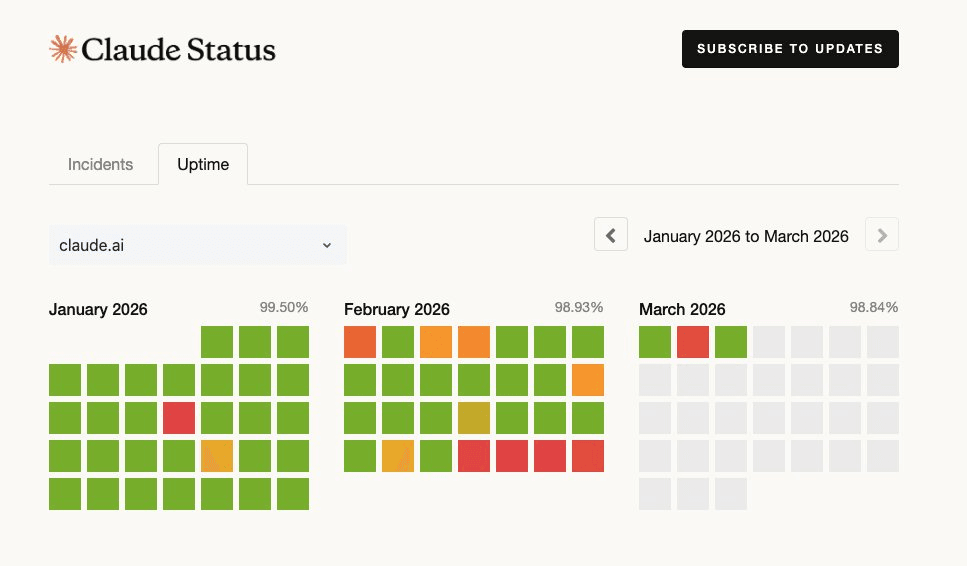
If it is ultimately confirmed that Iran was responsible, this would mark the first time in human history: a commercial data center physically destroyed in wartime.
But why would a civilian server facility be bombed?
Go back two days. On February 28, the United States and Israel carried out joint airstrikes on Iran, killing Supreme Leader Ali Khamenei and a number of senior officials.
A significant portion of the intelligence analysis, target identification, and battlefield simulations behind the strike was assisted by Claude. Through cooperation between the military and the data analytics company Palantir, Claude had already been embedded in the U.S. military’s intelligence systems.
Ironically, just hours before the airstrike, Trump had ordered a comprehensive ban on Anthropic because the company refused to hand its AI over to the Pentagon without restrictions. But ban or not, the war still had to be fought.
Officially, it would take at least six months to remove Claude from the military’s systems.
So before the ink on the ban had even dried, the U.S. military went ahead and used Claude to strike Iran. Then Iran retaliated, and a missile landed on the data center running Claude AI.
The data center was most likely not deliberately targeted and was simply caught in the blast. But whether the missile was aimed at the facility or not, one thing is certain:
Truth lies within the range of artillery—and now, so does AI. On both sides: those firing the artillery and those being hit by it.
AI megainfrastructure built on the Middle East powder keg
Over the past three years, Silicon Valley has effectively moved half of the AI industry into the Gulf in the Middle East.
The reasons are simple. The UAE and Saudi Arabia have the world’s richest sovereign wealth funds, cheap electricity, and one key rule:
If you want to serve our customers, the data has to be stored on our soil.
So Amazon has opened data centers in the UAE and Bahrain, and is investing another $5.3 billion to build one in Saudi Arabia; Microsoft has nodes in the UAE and Qatar, and its Saudi facility has also been completed.
OpenAI, together with Nvidia and SoftBank, is building an AI complex in the UAE worth more than $30 billion, touted as the largest computing hub outside the United States.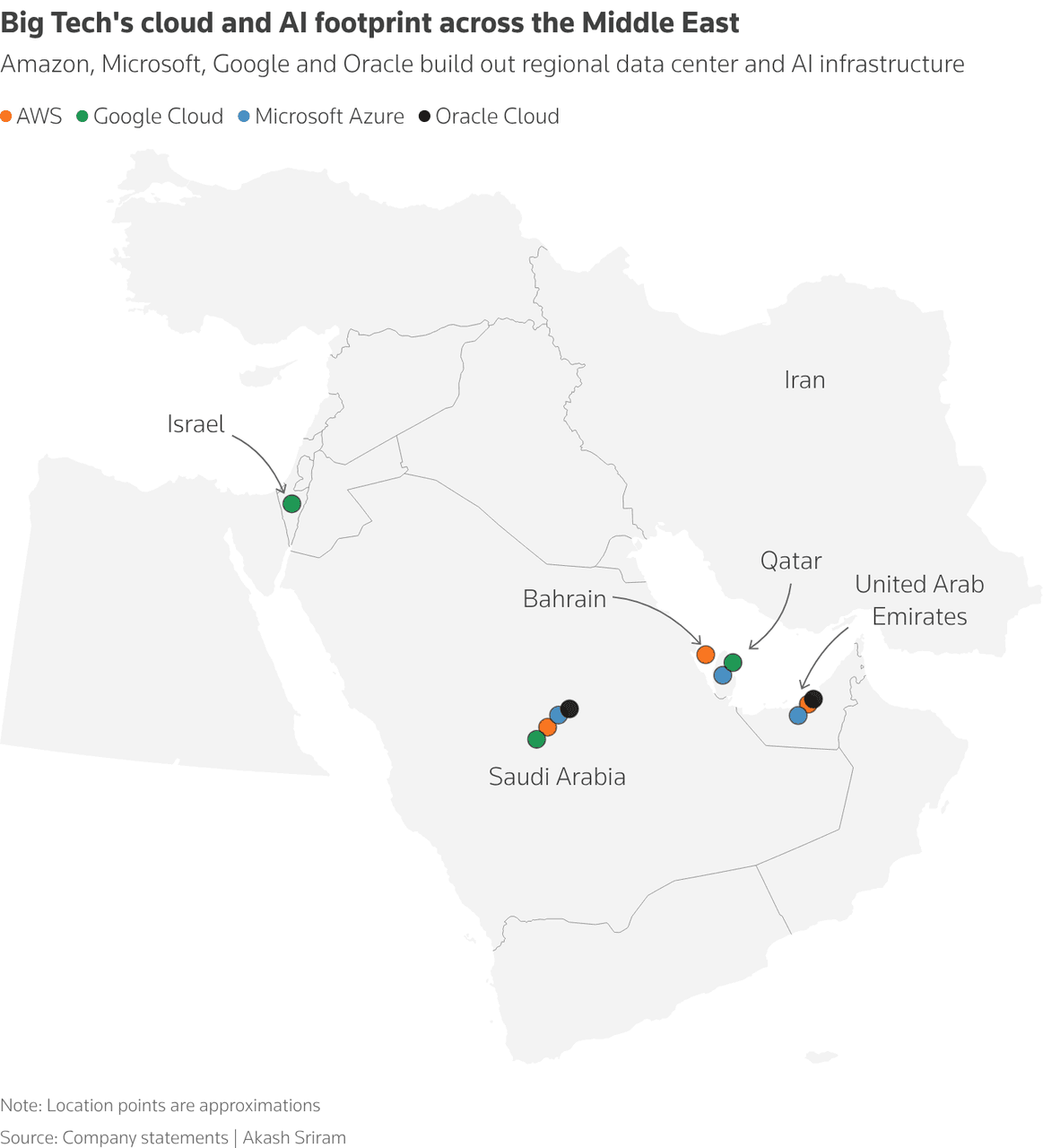
In January this year, the United States brought the UAE and Qatar together to sign an agreement called “Pax Silica.” Translated literally, it means “Peace of Silicon,” and it sounds beautiful.
The core of the agreement is to control the flow of chips and ensure that advanced semiconductors do not end up in China’s hands.
In return, the UAE obtained permission to import hundreds of thousands of Nvidia’s most advanced processors each year. Abu Dhabi’s G42 cut ties with Huawei, and Saudi AI companies pledged not to purchase Huawei equipment…
Across the Gulf, the entire AI infrastructure—from chips to data centers to models—has tilted fully toward the United States.
These agreements considered everything: chip export controls, data sovereignty, reciprocal investment, and the risk of technology leakage.
But not a single clause considered that someone might use missiles to blow up a data center.
After seeing the Amazon data center catch fire, an international security scholar from Qatar University said something that feels particularly fitting:
“These security frameworks were designed for supply chain control and political alignment. Physical security was never on the agenda.”
For a decade, the story cloud computing has told is one of elasticity, redundancy, and decentralization. But data centers are buildings with addresses. They have walls, roofs, and coordinates. No matter how advanced your chips are, if the facility is bombed, it’s bombed.
“The cloud” is a metaphor. A data center is not.
AI looks intangible—running in code, floating in the cloud. But code runs on chips, chips sit in data centers, and data centers are built on the Earth.
Who protects AI?
This time, the Amazon data center can be said to have been collateral damage—if you look on the bright side, even accidental.
But what about the next time?
As global geopolitical conflicts intensify, if your data center is running AI models that help an opponent with target identification, the opponent has every reason to treat your facility as a military target.
International law has no clear answer to this problem.
Existing laws of war do contain provisions for “dual-use infrastructure,” but those clauses were written with factories and bridges in mind—no one was thinking about data centers.
If a facility runs banking transactions during the day and military intelligence analysis at night, is it civilian or military?
In peacetime, choosing a location for a data center is about latency, electricity prices, and policy incentives… When war arrives, none of that matters anymore. What matters is how far your facility is from the nearest military base.
So this bombing has started to shift people’s attention.
Until now, everyone has been discussing the same anxiety: whether AI will replace their jobs. But almost no one has been asking another question:
Before AI replaces you, how vulnerable is it itself?
A single regional conflict was enough to knock out the Middle East node of one of the world’s largest cloud providers for nearly an entire day—and that was just one data center.
There are now nearly 1,300 hyperscale data centers around the world, with another 770 under construction. These facilities consume ever more electricity, water, and capital, while carrying ever more of the world’s critical functions—your bank deposits, your medical records, your food delivery orders, even a nation’s military intelligence.
Yet the systems protecting these facilities may still amount to little more than fire suppression and backup generators.
When AI becomes part of a country’s core infrastructure, its security is no longer just the responsibility of a single company. Who protects AI? Cloud providers? The U.S. Pentagon? Or the UAE’s air defense systems?
Three days ago, this was still a theoretical question. Now it isn’t.
AI is within artillery range. And in this era, what isn’t?
You may also like

March 4th Market Key Intelligence, How Much Did You Miss?

Taking Stock of Crypto's Washington Power Players: Who is Advocating for US Crypto Regulation?

DDC Enterprise Limited Announces 2025 Unaudited Preliminary Financial Performance: Record Revenue Achieved, Bitcoin Treasury Grows to 2183 Coins
On March 4, 2026, DDC Enterprise Limited (NYSE American: DDC) today announced preliminary, unaudited full-year financial performance for the year ended December 31, 2025. The company expects to achieve record revenue and record positive adjusted EBITDA, primarily driven by continued growth in its core consumer food business and overall margin improvement. The final audited financial report is expected to be released in mid-April 2026.
Revenue: Expected to be between $39 million and $41 million, reaching a new company high.
Organic Growth: Excluding the impact of the company's strategic contraction of its U.S. operations, core revenue is expected to grow 11% to 17% year over year.
Gross Profit Margin: Expected to be between 28% and 30%, reflecting continued operational efficiency improvements.
Adjusted EBITDA: The company expects to achieve a positive full-year result in 2025, a significant improvement from a $3.5 million loss in 2024, mainly due to rigorous cost controls and a higher-margin sales mix.
In 2025, DDC's core consumer food business maintained strong operational performance.
The company also disclosed Core Consumer Food Business Adjusted EBITDA, a metric that further excludes costs related to its Bitcoin reserve strategy and non-cash fair value adjustments related to its Bitcoin holdings from adjusted EBITDA to more accurately reflect the core business performance.
In 2025, Core Consumer Food Business Adjusted EBITDA is expected to be between $5.5 million and $6 million.
In the first half of 2025, DDC initiated a long-term Bitcoin accumulation strategy, holding Bitcoin as its primary reserve asset.
As of December 31, 2025: The company holds 1,183 BTC.
As of February 28, 2026: Holdings increased to 2,118 BTC
Today's additional purchase of 65 BTC brings the company's total holdings to 2,183 BTC
DDC Founder, Chairman, and CEO Norma Chu stated, "We are proud to have closed 2025 with record revenue and positive adjusted EBITDA, demonstrating the steady growth of the company's consumer food business and the ongoing improvement in profitability. We are building a disciplined, growth-oriented food platform and strategically allocating capital to Bitcoin assets with a long-term view, aligning with our core beliefs. We believe that this dual-track model of 'Steady Consumer Business + Strategic Bitcoin Reserve' will help DDC create lasting long-term value for shareholders."
For the full year 2025, the company defines "Adjusted EBITDA" (a non-GAAP financial measure) as: Net income / (loss) excluding the following items:· Interest expense· Taxes· Foreign exchange gains/losses· Long-lived asset impairment· Depreciation and amortization· Non-cash fair value changes related to financial instruments (including Bitcoin holdings)· Stock-based compensation
DDC Enterprise Limited (NYSE: DDC) is actively implementing its corporate Bitcoin Treasury strategy while continuing to strengthen its position as a leading global Asian food platform.
The company has established Bitcoin as a core reserve asset and is executing a prudent, long-oriented accumulation strategy. While expanding its portfolio of food brands, DDC is gradually becoming one of the public company pioneers in integrating Bitcoin into its corporate financial architecture.

Uncovering YZi Labs 229 Investment: Over 18% of the portfolio is already inactive, with an average project transparency score of 78

The business of crypto VC is becoming promising

China's AI Compute Power Counterstrike

Global Assets Plunge: Hormuz, Chips, and a South Korean Holiday

Bloomberg has reported twice, Hyperliquid once again in Wall Street's radar

Trump Backs Crypto Bill, SEC Halts Leveraged ETF, What Is the English-Speaking Crypto Community Talking About?

OpenClaw Floods Into Polymarket, Some Making Tens of Thousands Per Month
Understanding Trump's "Warfare Playbook": Ten Signals Investors Must Know

Iranian Missile Heading Toward UAE, Claude Also Within Range
Successive Core Team "Heroes" Depart, Has Aave's DAO Dream Crumbled?

Is This the Year of the Robot? A Deep Dive into Robotics Projects
When AI Takes Over Money: Bitcoin Becomes the "First Choice," Fiat Is Left Out

AI Trading in Live Markets: 4 Lessons From a WEEX Hackathon Top 10 Finalist
AI trading meets real markets. Explore 4 lessons from a WEEX Hackathon Top 10 finalist on surviving volatility, trusting AI models, and building smarter crypto trading systems.

MegaETH Co-founder: 48 Hours After Leaving Dubai, I Reassessed the Entire Crypto Space

Web3 Winter Mass Exodus: Resignations, Closures, Transformations, and Acquisitions
March 4th Market Key Intelligence, How Much Did You Miss?
Taking Stock of Crypto's Washington Power Players: Who is Advocating for US Crypto Regulation?
DDC Enterprise Limited Announces 2025 Unaudited Preliminary Financial Performance: Record Revenue Achieved, Bitcoin Treasury Grows to 2183 Coins
On March 4, 2026, DDC Enterprise Limited (NYSE American: DDC) today announced preliminary, unaudited full-year financial performance for the year ended December 31, 2025. The company expects to achieve record revenue and record positive adjusted EBITDA, primarily driven by continued growth in its core consumer food business and overall margin improvement. The final audited financial report is expected to be released in mid-April 2026.
Revenue: Expected to be between $39 million and $41 million, reaching a new company high.
Organic Growth: Excluding the impact of the company's strategic contraction of its U.S. operations, core revenue is expected to grow 11% to 17% year over year.
Gross Profit Margin: Expected to be between 28% and 30%, reflecting continued operational efficiency improvements.
Adjusted EBITDA: The company expects to achieve a positive full-year result in 2025, a significant improvement from a $3.5 million loss in 2024, mainly due to rigorous cost controls and a higher-margin sales mix.
In 2025, DDC's core consumer food business maintained strong operational performance.
The company also disclosed Core Consumer Food Business Adjusted EBITDA, a metric that further excludes costs related to its Bitcoin reserve strategy and non-cash fair value adjustments related to its Bitcoin holdings from adjusted EBITDA to more accurately reflect the core business performance.
In 2025, Core Consumer Food Business Adjusted EBITDA is expected to be between $5.5 million and $6 million.
In the first half of 2025, DDC initiated a long-term Bitcoin accumulation strategy, holding Bitcoin as its primary reserve asset.
As of December 31, 2025: The company holds 1,183 BTC.
As of February 28, 2026: Holdings increased to 2,118 BTC
Today's additional purchase of 65 BTC brings the company's total holdings to 2,183 BTC
DDC Founder, Chairman, and CEO Norma Chu stated, "We are proud to have closed 2025 with record revenue and positive adjusted EBITDA, demonstrating the steady growth of the company's consumer food business and the ongoing improvement in profitability. We are building a disciplined, growth-oriented food platform and strategically allocating capital to Bitcoin assets with a long-term view, aligning with our core beliefs. We believe that this dual-track model of 'Steady Consumer Business + Strategic Bitcoin Reserve' will help DDC create lasting long-term value for shareholders."
For the full year 2025, the company defines "Adjusted EBITDA" (a non-GAAP financial measure) as: Net income / (loss) excluding the following items:· Interest expense· Taxes· Foreign exchange gains/losses· Long-lived asset impairment· Depreciation and amortization· Non-cash fair value changes related to financial instruments (including Bitcoin holdings)· Stock-based compensation
DDC Enterprise Limited (NYSE: DDC) is actively implementing its corporate Bitcoin Treasury strategy while continuing to strengthen its position as a leading global Asian food platform.
The company has established Bitcoin as a core reserve asset and is executing a prudent, long-oriented accumulation strategy. While expanding its portfolio of food brands, DDC is gradually becoming one of the public company pioneers in integrating Bitcoin into its corporate financial architecture.


 App
App