
- Buy Crypto
- Markets
 Futures
- Spot
- Copy Trade
- Earn
- More
Samara Asset Group Launches Bitcoin CPI as a New Inflation Benchmark
By: cryptonews|2025/05/07 15:15:01
0
Share
In corporate finance, inflation is often accepted as an unavoidable force—something to hedge against, but never escape. Every fiscal model, investment thesis, and capital plan ultimately bends around it. But the way we measure inflation is rarely questioned. The Consumer Price Index (CPI) , the world’s default inflation gauge, measures price changes of a basket of goods in fiat currency. But here’s the problem: fiat currencies are designed to lose value. This means we’re measuring rising prices with a yardstick that’s shrinking. Now, Samara Asset Group , an executive member of Bitcoin For Corporations (BFC), is challenging that convention. They’ve launched the world’s first Bitcoin Consumer Price Index (BTCCPI) —a bold new benchmark that prices the same CPI basket in Bitcoin instead of fiat. It’s a subtle shift with profound implications: Bitcoin isn’t just an asset—it may be a better measure of value. A Yardstick That Doesn’t Melt Think of CPI as a thermometer—only the mercury keeps rising not just because the heat is increasing, but because the scale is broken. Traditional CPI always trends upward, not necessarily because goods become more valuable, but because the purchasing power of fiat currency is constantly eroded by inflationary policy. Samara’s BTCCPI flips the framing. By expressing the same CPI basket in Bitcoin, the index reflects what happens when measured against a supply-capped, non-sovereign monetary standard. And what it reveals is striking: over the long term, prices trend downward. The BTCCPI doesn’t ignore Bitcoin’s volatility—but it reframes it. In short-term windows, prices fluctuate. But across longer timeframes, Bitcoin holds purchasing power far better than fiat. This is not just a reframing of inflation. It’s a more honest way to assess whether capital is holding its value—or being silently diluted. What It Means for Corporate Treasuries Corporate finance teams think in terms of performance, preservation, and predictability. But preservation is the one that’s hardest to measure—especially in fiat terms. The BTCCPI offers an emerging class of Bitcoin Treasury Companies a new tool: a way to benchmark the real-world strength of their treasury strategy. A company that holds Bitcoin on its balance sheet isn’t just making a speculative bet—it’s aligning its capital with a monetary system that is structurally deflationary. This changes the story you can tell shareholders. It reinforces the idea that your treasury isn’t just surviving inflation—it’s resisting it. That you’re anchoring corporate value to a global, neutral, incorruptible base layer. In that light, BTCCPI is more than a chart. It’s a signal. A tool to communicate value preservation in a world where most assets quietly erode. Why Samara’s Move Matters Plenty of firms talk about inflation. Samara built a new way to measure it. Their launch of BTCCPI is not a thought experiment or a marketing stunt. It’s a live,> Toward a New Benchmark for Honest Capital CFOs have always relied on trusted benchmarks: CPI, LIBOR, the 10-year yield, the S&P. But each of those reflects a world built on fiat assumptions. Bitcoin offers something different. A monetary system where supply is fixed, issuance is transparent, and value isn’t manipulated by policy or politics. Samara’s BTCCPI is one of the first attempts to use that system as a lens , not just a ledger. It invites us to ask: what if we’ve been measuring inflation incorrectly? What if the signal we’ve been using to manage capital is inherently distorted? And what if there was a better benchmark—not just for inflation, but for honest capital? Thanks to Samara, we now have the beginning of an answer. This post Samara Asset Group Launches Bitcoin CPI as a New Inflation Benchmark first appeared on Bitcoin Magazine and is written by Nick Ward.
You may also like

Particle Founder: The entrepreneurial insights I have gained the most from in the past year
Stop lean startup, stop lightning entrepreneurship, and think carefully about what your product aspirations are.

Huang Renxun's latest podcast transcript: The future of Nvidia, the development of embodied intelligence and agents, the explosion of inference demand, and the public relations crisis of artificial intelligence
The competition in the future is not just about whose model is larger or whose computing power is stronger, but also about who understands the industry better, who can embed AI more deeply into real processes, and who can organize these capabilities into a runnable and scalable system.

OKX Ventures Research Report: AI Agent Economic Infrastructure Research Report (Part 1)
The existing infrastructure is hostile to the Agent economy. Agents can think and act independently at the "capability level," but at the "economic level," they are still locked into infrastructure designed for humans.

The migration of settlement rights: B18 and the institutional starting point of on-chain banks
In the traditional system, banks decide the settlement; in the on-chain system, code begins to take over this responsibility.

From Tencent and Circle: Looking at the Simple and Difficult Questions of Investment
The AI narrative continues to ferment, but the recent performance of related stocks varies, with some in the midst of summer and others as if in winter.

The second half of stablecoins no longer belongs to the crypto circle
What Coinbase doesn't want, Mastercard is eager to buy.

Cursor "Shell" Kimi Controversy Reversed: From Copyright Infringement Allegations to Authorized Collaboration, China's Open Source Model Once Again Becomes a Global AI Foundation
Cursor was accused of being based on Kimi K2.5, which sparked controversy, and was later confirmed to be compliant through Fireworks AI due diligence.

The Real Reason Tokens Don't Sell: 90% of Crypto Projects Overlook Investor Relations
Provide an Investor Relations Best Practices Guide for Crypto Projects.

Is the income of pump.fun real, earning a million dollars a day despite the market downturn?
If it can really earn this much, what is the reason for the low price of $PUMP?

The real reason why tokens are not selling: 90% of crypto projects neglect investor relations
Investor Relations Practice Guide for Cryptocurrency Projects.

Who is the true winner of the "Tokenization" narrative?
Virtually everyone benefits, but the reason for the benefit, the timing, and the underlying logic are completely different.

Moss: The Era of AI-Traded by Anyone | Project Introduction
AI Trading Agent is rapidly growing its infrastructure.

Chip Smuggling Case Exposes Regulatory Loophole | Rewire News Evening Update
AI chips have become a strategic asset more sensitive than missiles

How a Structured AI Crypto Trading Bot Won at the WEEX Hackathon
Ritmex demonstrates how disciplined risk control and structured signals can make an AI crypto trading bot more stable and reliable on WEEX, highlighting the importance of combining execution discipline with scalable AI trading systems.

Old Indicator Fails, Three Major New Signals Emerge: BTC True Bottom May Still Be Below $60K
When the grocery shopping auntie on the subway, or Tony the hairdresser, start asking you about BTC, crypto, and cryptocurrency investments, selling immediately will be the only best option.

Meeting OpenClaw Founder at a Hackathon: What Else Can Lobsters Do?
Imperial College London MetaGame: AI Agent × Web3 Landing Three Major Directions.
Huang Renxun's Latest Podcast Transcript: NVIDIA's Future, Embodied Intelligence and Agent Development, Soaring Demand for Inferencing, and AI's PR Crisis
The future of competition is not only about whose model is bigger, whose computing power is stronger, but also about who understands the industry better, who can more deeply integrate AI into real processes, and who can organize these capabilities into a set of executable, scalable systems
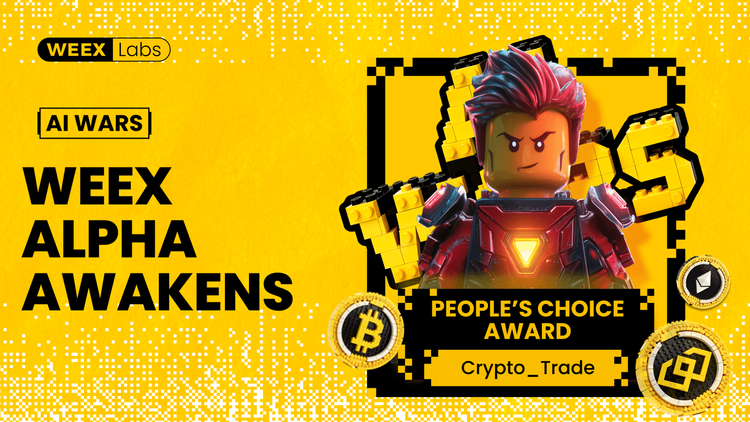
How a Structured AI Crypto Trading Bot Won at the WEEX Hackathon
Crypto_Trade shows how structured inputs and controlled adaptability can build a more stable and reliable AI crypto trading bot within the WEEX AI Trading Hackathon, highlighting a practical path toward scalable AI trading systems.
Particle Founder: The entrepreneurial insights I have gained the most from in the past year
Stop lean startup, stop lightning entrepreneurship, and think carefully about what your product aspirations are.
Huang Renxun's latest podcast transcript: The future of Nvidia, the development of embodied intelligence and agents, the explosion of inference demand, and the public relations crisis of artificial intelligence
The competition in the future is not just about whose model is larger or whose computing power is stronger, but also about who understands the industry better, who can embed AI more deeply into real processes, and who can organize these capabilities into a runnable and scalable system.
OKX Ventures Research Report: AI Agent Economic Infrastructure Research Report (Part 1)
The existing infrastructure is hostile to the Agent economy. Agents can think and act independently at the "capability level," but at the "economic level," they are still locked into infrastructure designed for humans.
The migration of settlement rights: B18 and the institutional starting point of on-chain banks
In the traditional system, banks decide the settlement; in the on-chain system, code begins to take over this responsibility.
From Tencent and Circle: Looking at the Simple and Difficult Questions of Investment
The AI narrative continues to ferment, but the recent performance of related stocks varies, with some in the midst of summer and others as if in winter.
The second half of stablecoins no longer belongs to the crypto circle
What Coinbase doesn't want, Mastercard is eager to buy.


 App
App