
 Buy Crypto
- Markets
 Futures
- Spot
- Copy Trade
- Earn
- More
They knew in advance that Trump would tweet about a ceasefire, entered with $20k, and exited with $400k.

24 hours ago, the Iranian Ministry of Foreign Affairs publicly announced the closure of the negotiation window, while Trump toughly stated, "If Iran does not open the Strait of Hormuz, it will destroy the entire civilization."
At that time, the prediction market priced the probability of "US and Iran reaching a ceasefire by April 7" at 4%.
It was in this geopolitical background that in less than 12 hours, the three warring parties declared a ceasefire, each claiming a "victory". The single-digit ceasefire probability instantly surged to 99%, the crude oil index plummeted by 15%, and even now, the market is still repricing the post-information.
However, there was a wave of people who had already started positioning for this ceasefire last month. On March 26th, Beijing time, the prediction market monitoring channel PolyBeats sent out a news flash:
6 insider accounts collectively invested $395k in "US-Iran will reach a ceasefire." Among them, $185k was invested in "ceasefire by March 31," and $99k was invested in "ceasefire by April 30."
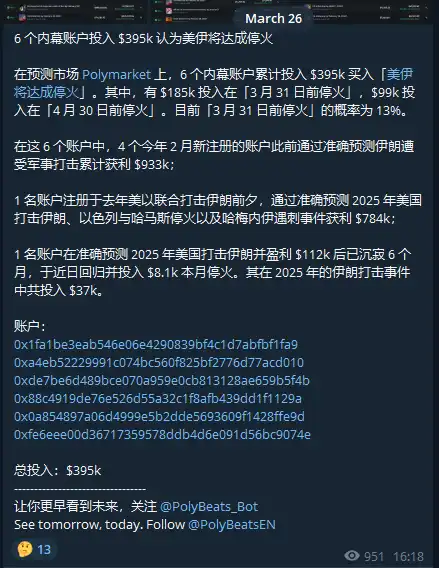
These people earned $1 million from this ceasefire event. The reason they are called "insiders" is precisely because they have replicated this astonishing trading operation multiple times.
A new account with a $20k deposit at the end of February withdrew $400k today
We take one of these 6 accounts as an example.
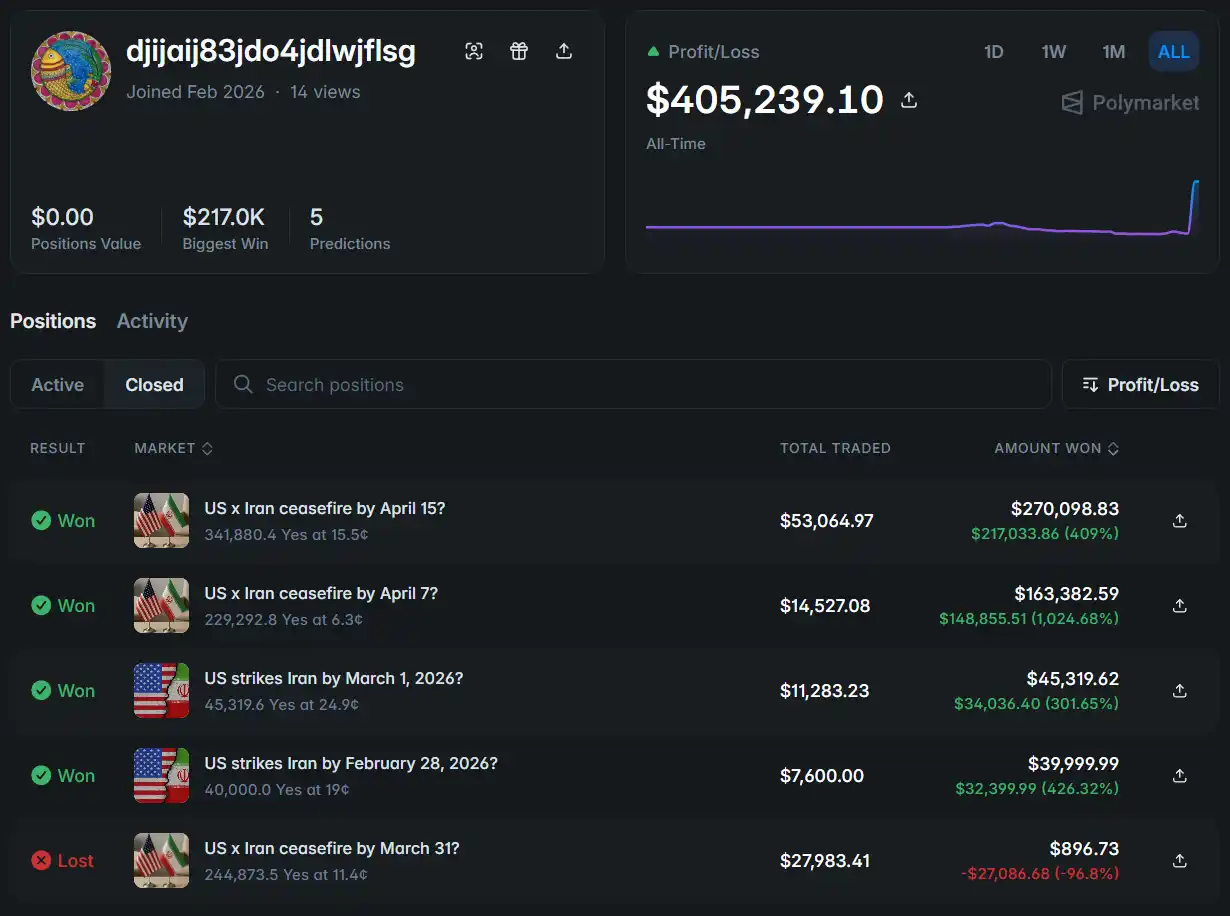
This account was registered six hours before the start of this round of Iran conflict. After depositing nearly $20,000, he used the entire $20,000 to "bet" that the United States would strike Iran in the next 48 hours.
We already know the outcome of this "bet": six hours later, the US and Israel jointly launched a fierce attack on Tehran, with US Tomahawk missiles reportedly hitting directly a girls' elementary school, causing at least 150 deaths of female students aged 7 to 12.
And this $20,000 "speculation" thus multiplied by 5 amidst the cries of the Iranian people.
Three weeks later, this account used nearly $100,000, including principal and interest, to bet that the US and Iran would cease fire at different time points. His final bet was at 5 a.m. on April 8th Beijing time.
1 hour and 32 minutes later, Trump posted on Truth Social claiming a "bilateral ceasefire" agreement had been reached.
This round of a $100,000 "bet" once again saw nearly 4x returns, with $20,000 turning into 20x in 5 weeks. Shortly after the ceasefire announcement, the account changed its username to a string of gibberish and promptly cashed out.
In addition to this account, the profiles of 5 other individuals were eerily similar:
4 were newly registered accounts in February this year, accurately timing the US strike against Iran during this round of Iran conflict, accumulating profits of nearly $1 million; 1 account registered in June 2025 bet on last year's Israel-Iran war, Israel-Hamas ceasefire, and the assassination of Iran's former Supreme Leader Khamenei, accumulating $780,000 in profits; and 1 account precisely timed the strike during the "Twelve-Day War" event in 2025, remained silent for a full 6 months after earning $110,000 in profits, and has recently returned to bet on this ceasefire.
These accounts' actions betting on the ceasefire since the end of March actually align perfectly with the contents of multiple reports after this ceasefire: the US-Iran ceasefire had been quietly laid out in the diplomatic background a month ago. Through multiple mediations and diplomatic efforts, a 10-point proposal initially rejected by Trump rapidly evolved into a "negotiable basis" in the past 48 hours.
These undisclosed negotiation details, unknown to the public, only manifested in the form of suspicious trades in the prediction markets following the trend of money. With this perspective, we continue to use prediction market data to analyze which direction the two weeks after the ceasefire will take.
Crude Oil Index Plummets: Will the Hormuz Strait Reopen?
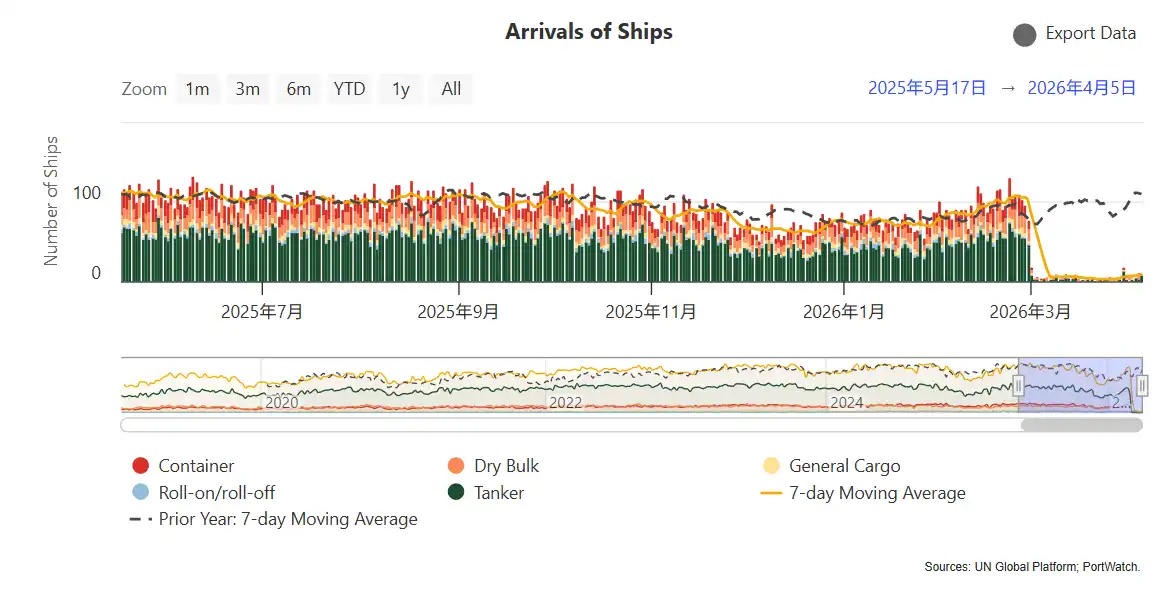
Since the start of the war, data from the global shipping data institution IWF shows that vessels transiting the Hormuz Strait have plummeted from a pre-war moving average of around 100 ships to less than 5 ships on average in the past three weeks—a drop of over 95%.
One of the most direct impacts of this ceasefire agreement is that the WTI crude oil price, which had soared around 70% since the start of the war, plummeted 15% from yesterday's $112. The market's initial reaction to the ceasefire is being interpreted as a signal that the Hormuz Strait is about to reopen.
The probability in the prediction market of "whether the Hormuz Strait will reopen this month" also had a similar response: the announcement of the ceasefire agreement has elevated the probability, initially at 14%, to a peak of 65%, and currently at 46%.
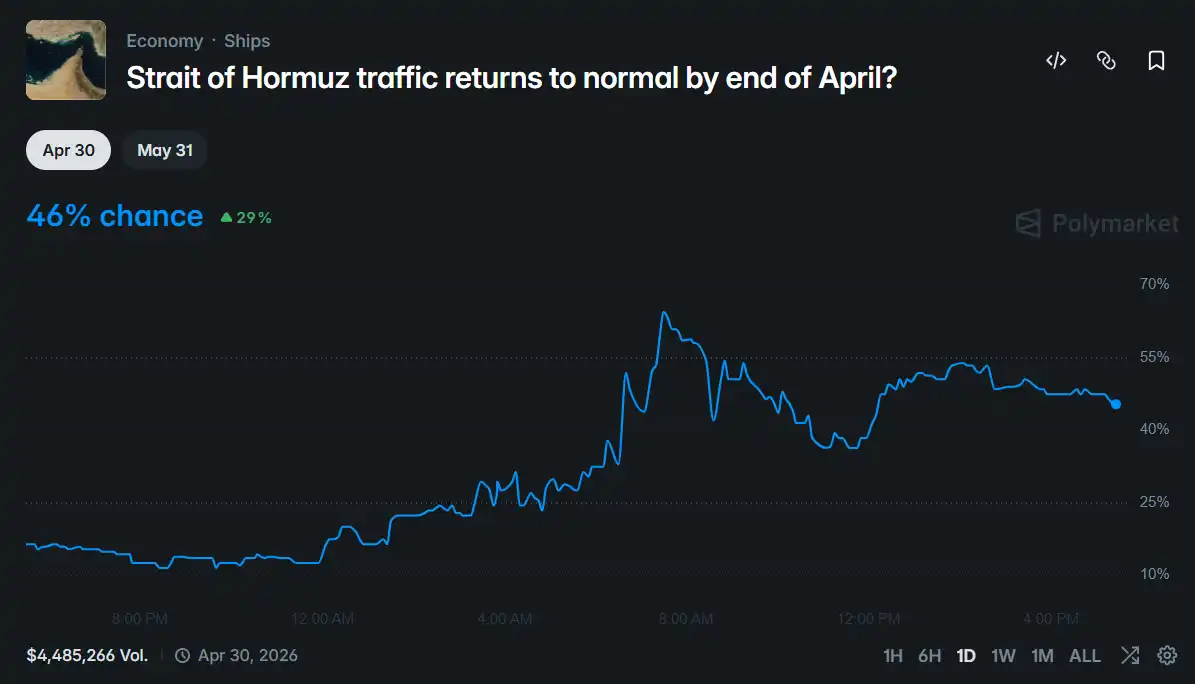
This data aligns closely with the current geopolitical situation: factors such as ship owner confidence, insurance rates, and Iran's actual openness are not as simple as a post by Trump. The current WTI crude oil price of $95 is still far from the pre-war level of around $55.
The NPA of Enriched Uranium
What is most unclear in the ceasefire terms is not the Strait of Hormuz, but the nuclear issue. The starting point difference between the two sides can be described as 'polar opposites.'
Prior to the war, the core of the failed US-Iran negotiations lay here: the US demanded Iran completely abandon its uranium enrichment capability, while Iran insisted on retaining the right to peaceful use of nuclear energy and offered to "downgrade" 60% enriched uranium in exchange for full sanctions relief.
The outbreak of war has further complicated this issue. According to the International Atomic Energy Agency (IAEA) records, Iran currently holds about 441 kilograms of 60% enriched uranium — with Iran's existing centrifuge capacity, they could theoretically reach weapons-grade purity in a matter of weeks.
In the ceasefire statement, Trump claimed that 'almost all points of dispute between the US and Iran have been agreed to in principle,' but the White House has not yet disclosed any terms details. The 10-point proposal text released by Iran is also very vague on the nuclear issue.
The probability on the prediction market of 'US-Iran nuclear agreement reached by April 30' was only 2% before the ceasefire announcement, but it has risen to 26% post-ceasefire.
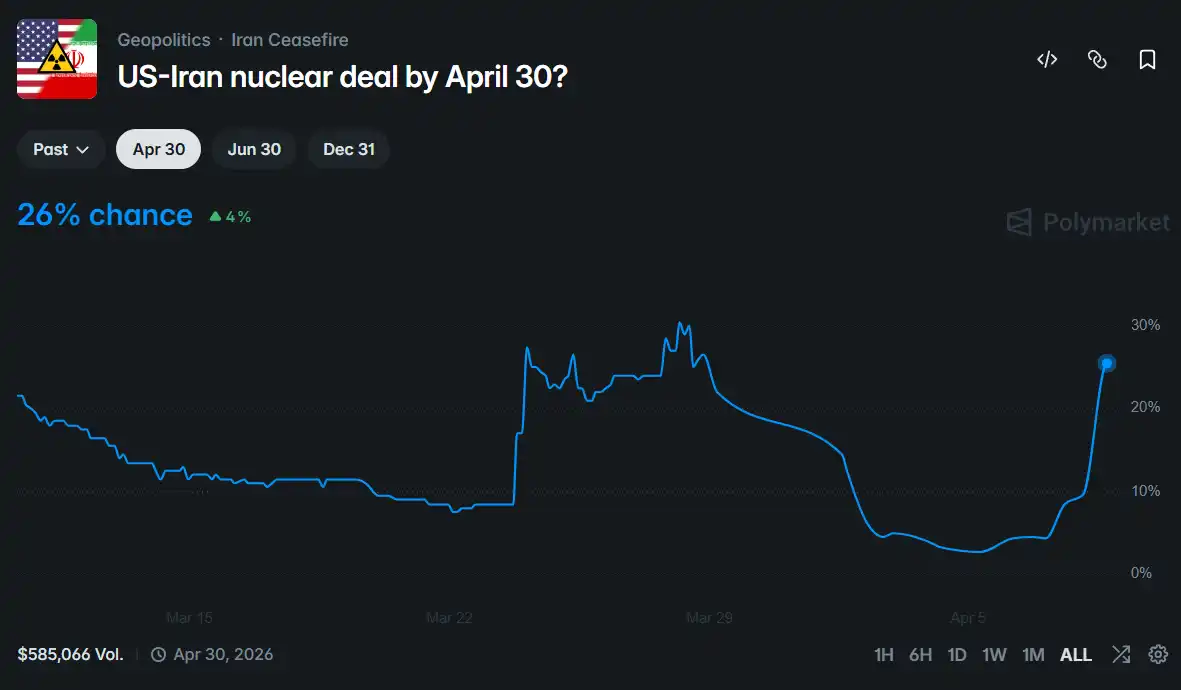
A 24% probability increase is significant, but the 76% 'no' consensus accurately reflects the true situation of the nuclear issue: the ceasefire has opened the door to negotiations, but what's inside that door is the toughest part of this conflict to crack.
The Palestinian Story, Replaying in Lebanon
Recent weeks have seen US-Iran news dominate the headlines, with many media outlets even completely ignoring an important participant in this round of ceasefire agreement reporting: Israel.
Israel has indeed agreed to the ceasefire: a statement from Netanyahu's office clearly asserts that 'Israel supports Trump's decision to temporarily halt strikes against Iran for two weeks, but — the ceasefire does not include Lebanon.'
This directly contradicts what Pakistani Prime Minister Sharif stated in the ceasefire announcement, that it includes 'all warring parties in Lebanon and other regions.' In the past six weeks, Israel's actions in Lebanon have been much deeper than what news reports have presented.
On March 1, on the same day as the US-Israel joint strike against Iran, Israel began deploying ground forces to southern Lebanon. On March 16, the IDF announced the official start of a ground invasion operation with the objective of occupying the entire area south of the Litani River, establishing a "Forward Defense Zone."
Subsequently, Israel deployed an additional three brigades to Lebanon, blowing up all major bridges over the Litani River to cut off the south from the outside world. Israeli Defense Minister Katz explicitly stated that this operation was "just like what we did in Gaza" and declared that Lebanese southern residents would not be allowed to return home until the Hezbollah threat was eliminated.
In Iran's proposed 10-point ceasefire plan, it explicitly demanded the "cessation of the war on all members of the Axis of Resistance"—Hezbollah being a core part of Iran's proxy network. However, Israel's position is equally clear: the Lebanon issue is not within the scope of this ceasefire.
The predicted market probability of an "Israel-Hezbollah ceasefire this month" is currently around 56%. This pricing reflects a certain reality: even if the US-Iran ceasefire agreement explicitly includes "Lebanon," whether Israel will actually back down is a completely separate variable.
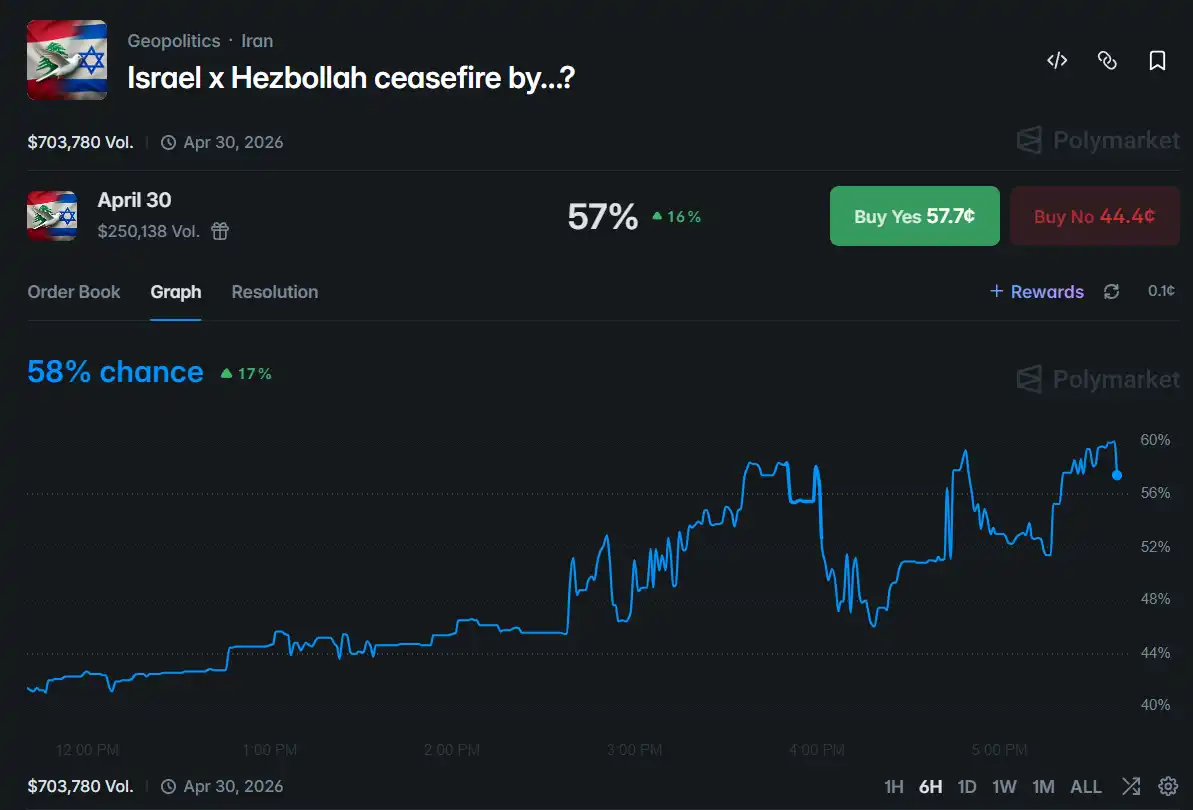
This logic is not unfamiliar. After the 2023 Gaza ceasefire agreement was signed, Israel's military actions did not cease. The reality left from that 29-month ground operation, from the ceasefire to today, can be copied word for word to the current situation in Lebanon: "ceasefire," "buffer zone," "temporary occupation," "waiting for the threat to be eliminated."
During a UN Security Council meeting on January 3, 2025, Palestinian Permanent Observer to the United Nations Riyad Mansour quoted a message from Gaza doctor Mahmoud Abu Nujaila on a whiteboard:
Do not forget us, do not turn us into numbers. We love life. We have dreams just like you. We have our beloved children and wives...
Since Trump's introduction of the "20-point Gaza Peace Plan," international reporting on the Gaza issue has gradually been replaced by other narratives. As the humanitarian topic of Gaza fades from view, Israel, under the cover of the "Peace Plan," continues to heavily strike the "Hamas terrorist forces" in Gaza, even with corresponding daily settlement events in the prediction market.
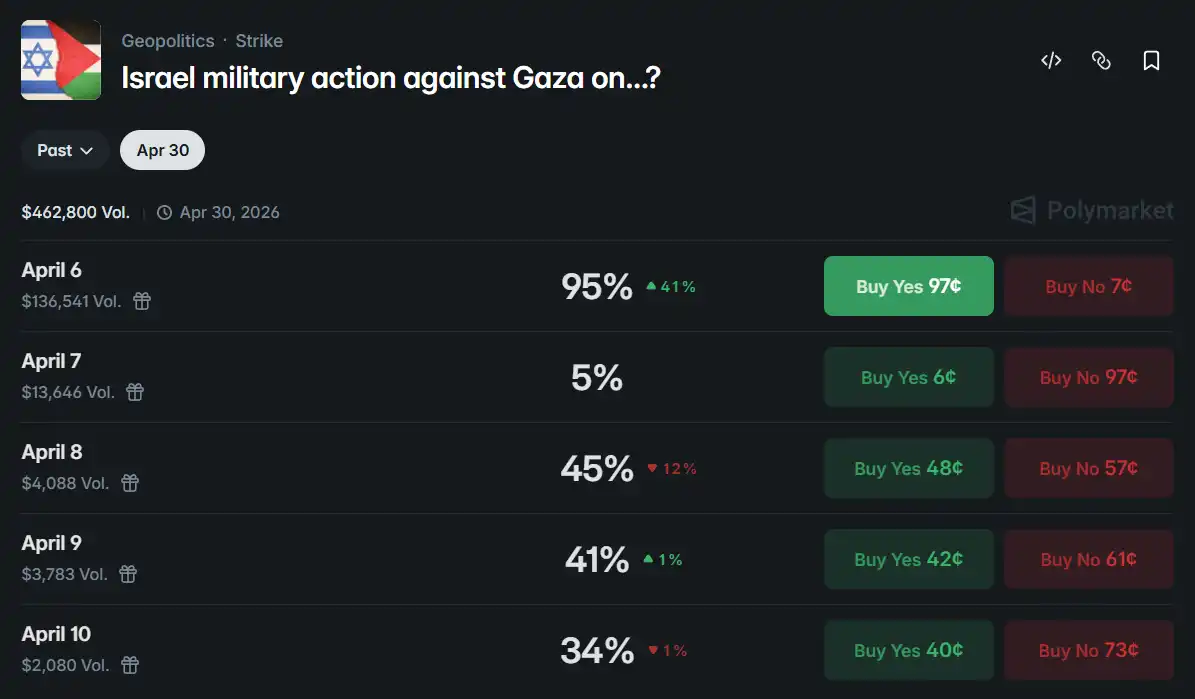
The story of Palestine, starting from the ceasefire, is still ongoing. The Lebanese version may have just begun.
From Ceasefire to Permanent Peace: How Far Away Are We?
This ceasefire between the US and Iran is the best option for both parties under current circumstances.
For Iran, it is currently the moment with the most negotiation leverage throughout the entire war—the Strait of Hormuz blockade has driven up global oil prices, the proxy network has not been completely dismantled, and the new leader's narrative of resistance has united domestic support. However, if the conflict continues, the positions of Gulf countries like Saudi Arabia and the UAE will gradually align with the US and Israel, eroding Iran's strategic advantage over time. A ceasefire now is the rational choice.
For Trump, the ceasefire is also a card he urgently needs. The S&P 500 index has been in continuous decline since the start of the war, gasoline prices have surged from $2.98 pre-war to $3.98, and Trump's overall approval rating has fallen to 36%. He vehemently declared "no new wars" during his campaign, yet he is now deeply involved in the Middle East conflict—a ceasefire, at least narratively, is a passable answer he can present to his domestic voters.
However, Iran has a fundamental historical suspicion that cannot be allayed by a two-week ceasefire: the last time US-Iran negotiations were described by all parties as "productive" and even "within reach of a historic agreement," the US and Israel launched a sudden attack directly at the negotiation table.
This time, Iran's acceptance of the ceasefire is not based on trust but on a calculation of interests. If the US defaults again, Iran will be in a more advantageous position in international public opinion than it is now; if the agreement is honored, Iran has secured the most favorable negotiation outcome under current conditions. This is a game choice that is not a loss no matter what.
But "not a loss" does not equate to "moving towards peace."
On April 10, the Islamabad negotiations officially began. The nuclear issue, the Strait of Hormuz, Hezbollah, sanctions relief—each of these four cards, presented individually, is enough to cause the negotiations to collapse. Whether a two-week window is enough to even form a preliminary framework on these issues remains unknown.
In the prediction market, of those 6 insiders, only 1 has left the betting table. Where the remaining 5 place their next bets may be more worth watching than any diplomatic statement.
You may also like

Ray Dalio's new article: The world is entering a war cycle

IOSG: When Fintech Meets Crypto Native: The Next Decade of Digital Finance

The biggest bottleneck in DeFi development

CZ Memoir Released: Reveals a Large Amount of Industry Insider Information, Prompting Intense Rebuttal from Xu Mingxing

a16z: After securities are on the blockchain, why will intermediary institutions be replaced by code?

XRP Tokyo Is Here: What We Learn and What’s Next for XRP Price
Key Takeaways: Ripple’s 2025 XRP Tokyo event highlights a projected $33 trillion on-chain stablecoin volume by 2026. Significant…

Solana’s Future: Navigating the $285M Hack, Rug Pulls, and Milei Libra Scandal
Key Takeaways: Multiple Crises: Solana faces a $285 million hack, allegations of rug pulls, and the Milei Libra…

BTC USD Faces Tension: Markets React to Trump’s Dire Warning
Key Takeaways: Bitcoin’s price drops sharply below $70,000 amid geopolitical tensions, playing off Trump’s dramatic 8 PM ultimatum…
Bitcoin Price Surge: Ceasefire Sparks Optimism Hits $71K
Key Takeaways: After the US-Iran ceasefire announcement, Bitcoin surged beyond $71,000, marking its highest in a month. A…

Ethereum Price Forecast: Record $180 Billion Stablecoin Supply Marks Buyers’ Return
Key Takeaways: Ethereum’s stablecoin supply has surged to a record $180 billion, marking a 150% increase over the…

Emerging Evidence Links Argentina’s Milei to LIBRA Crypto Scandal
Key Takeaways: Evidence unveiled by Argentina’s federal prosecutors links President Javier Milei to the LIBRA token through call…

US Spot Bitcoin ETFs See Surge as BTC Nears $70K; LiquidChain and Layer-3 DeFi Rise
Key Takeaways: U.S. spot Bitcoin ETFs absorbed $471 million in a single day, moving BTC closer to the…

Bitcoin Price Prediction: Decoupling from Tech Stocks, Shaped by Geopolitics and AI Turmoil
Key Takeaways: Bitcoin is decoupling from tech stocks as geopolitical tensions and AI crises reshape the market, currently…

Chaos Labs Departure Leaves Aave Without Risk Management Amidst Governance Conflict
Key Takeaways: Aave, with a $50 billion TVL, is currently operating without a risk manager due to Chaos…
Grayscale Ethereum ETF Staking: A New Catalyst for $5,700?
Key Takeaways: Grayscale’s Ethereum Staking ETF introduces a yield-bearing structure that could significantly reshape investor sentiment. Ethereum’s price…

Polygon Crypto Enhances Finality Through the Giugliano Hardfork
Key Takeaways: Polygon’s Giugliano hardfork is operational on the mainnet, effectively reducing transaction finality by 2 seconds. The…

Senate’s Three-Week Deadline: Ripple XRP and the CLARITY Act’s Critical Moment
Key Takeaways: The Senate Banking Committee’s decision on the CLARITY Act in late April could define XRP’s future…
Solana Foundation Introduces STRIDE for DeFi Security
Key Takeaways: STRIDE is a structured security evaluation program for Solana’s DeFi ecosystem, managed by Asymmetric Research. It…
Ray Dalio's new article: The world is entering a war cycle
IOSG: When Fintech Meets Crypto Native: The Next Decade of Digital Finance
The biggest bottleneck in DeFi development
CZ Memoir Released: Reveals a Large Amount of Industry Insider Information, Prompting Intense Rebuttal from Xu Mingxing
a16z: After securities are on the blockchain, why will intermediary institutions be replaced by code?
XRP Tokyo Is Here: What We Learn and What’s Next for XRP Price
Key Takeaways: Ripple’s 2025 XRP Tokyo event highlights a projected $33 trillion on-chain stablecoin volume by 2026. Significant…


 App
App