
- Buy Crypto
- Markets
 Futures
- Spot
- Copy Trade
- Earn
- More
Treasury Official Confirms UK Won’t Hold Bitcoin
By: cointribuneen|2025/05/07 15:30:02
0
Share
While several economic powers are considering integrating bitcoin into their reserves, the United Kingdom opts for a strategic break. No national crypto reserve will be created, the Treasury confirmed at the FT Digital Asset Summit in London. This decision sharply contrasts with the offensive approach of the United States under the Trump administration. What does this choice reveal about the British crypto vision? And what will be the implications for London’s place in the global digital ecosystem? London draws a red line : no national crypto reserve Speaking at the Digital Asset Summit organized by the Financial Times in London from May 6 to 7, 2025, the British Treasury’s Economic Secretary, Emma Reynolds, flatly ruled out the idea that the United Kingdom could establish a national crypto reserve. Asked about the possibility of following the American momentum, Reynolds stated : This official statement marks a clear refusal of any public bitcoin or other crypto storage strategy by the British state. Such a stance clearly stands out from the current attitude in the United States, where the Trump administration adopts a openly crypto-friendly stance. By refusing to imitate this trend, the United Kingdom asserts a cautious and sovereign direction. Here are the key elements that structure this rejection: The British government does not consider bitcoin as an asset suitable for sovereign reserve management ; The American approach, centered on the strategic accumulation of bitcoin by the federal government, is seen as not transferable to the British context ; The British Treasury favors a more conservative and institutional vision of cryptos, where the state remains in the background ; This position fits within a broader framework of public risk aversion towards volatile assets, even amid growing adoption. By drawing this red line, the United Kingdom clearly indicates that it does not intend to transform its reserves into crypto instruments. This choice illustrates a stance of perceived responsibility that aims to preserve financial stability and national budgetary credibility in the face of a market still deemed too uncertain. Another ambition : regulate and innovate rather than store While the United Kingdom refuses to use bitcoin as a reserve asset, this does not mean disengagement from the crypto field. Emma Reynolds specified that the British government is actively studying the issuance of sovereign debt via blockchain technology. “We are examining the potential to issue public debt using distributed ledger technologies (DLT),” she stated. A vendor selection procedure is already underway, with a goal of designation “by the end of summer,” showing a clear interest in the concrete use of Web3 technologies in market infrastructures. In another area, the Economic Secretary revealed the establishment of a high-level working group between the United Kingdom and the United States, aimed at fostering regulatory cooperation on these assets. This bilateral body, described as a “regulatory forum,” will hold a meeting as early as June. However, Reynolds emphasized that this collaboration does not mean systematic alignment with American or European approaches. She notably clarified that the United Kingdom will not reproduce the EU’s MiCA regulatory framework, preferring an “outcome-based” approach integrated into the traditional financial services perimeter. This strategic choice, based on the principle of “same risk, same regulation,” opens an intermediate path between American crypto activism and European normative rigor. It could enable the United Kingdom to position itself as a hub of regulated innovation, capable of attracting blockchain players while ensuring the stability of the financial system. It remains to be seen whether this hybrid stance, which favors controlled experimentation over direct investment, will be sufficient to keep London in the race for global crypto leadership.
You may also like

Particle Founder: The entrepreneurial insights I have gained the most from in the past year
Stop lean startup, stop lightning entrepreneurship, and think carefully about what your product aspirations are.

Huang Renxun's latest podcast transcript: The future of Nvidia, the development of embodied intelligence and agents, the explosion of inference demand, and the public relations crisis of artificial intelligence
The competition in the future is not just about whose model is larger or whose computing power is stronger, but also about who understands the industry better, who can embed AI more deeply into real processes, and who can organize these capabilities into a runnable and scalable system.

OKX Ventures Research Report: AI Agent Economic Infrastructure Research Report (Part 1)
The existing infrastructure is hostile to the Agent economy. Agents can think and act independently at the "capability level," but at the "economic level," they are still locked into infrastructure designed for humans.

The migration of settlement rights: B18 and the institutional starting point of on-chain banks
In the traditional system, banks decide the settlement; in the on-chain system, code begins to take over this responsibility.

From Tencent and Circle: Looking at the Simple and Difficult Questions of Investment
The AI narrative continues to ferment, but the recent performance of related stocks varies, with some in the midst of summer and others as if in winter.

The second half of stablecoins no longer belongs to the crypto circle
What Coinbase doesn't want, Mastercard is eager to buy.

Cursor "Shell" Kimi Controversy Reversed: From Copyright Infringement Allegations to Authorized Collaboration, China's Open Source Model Once Again Becomes a Global AI Foundation
Cursor was accused of being based on Kimi K2.5, which sparked controversy, and was later confirmed to be compliant through Fireworks AI due diligence.

The Real Reason Tokens Don't Sell: 90% of Crypto Projects Overlook Investor Relations
Provide an Investor Relations Best Practices Guide for Crypto Projects.

Is the income of pump.fun real, earning a million dollars a day despite the market downturn?
If it can really earn this much, what is the reason for the low price of $PUMP?

The real reason why tokens are not selling: 90% of crypto projects neglect investor relations
Investor Relations Practice Guide for Cryptocurrency Projects.

Who is the true winner of the "Tokenization" narrative?
Virtually everyone benefits, but the reason for the benefit, the timing, and the underlying logic are completely different.

Moss: The Era of AI-Traded by Anyone | Project Introduction
AI Trading Agent is rapidly growing its infrastructure.

Chip Smuggling Case Exposes Regulatory Loophole | Rewire News Evening Update
AI chips have become a strategic asset more sensitive than missiles

How a Structured AI Crypto Trading Bot Won at the WEEX Hackathon
Ritmex demonstrates how disciplined risk control and structured signals can make an AI crypto trading bot more stable and reliable on WEEX, highlighting the importance of combining execution discipline with scalable AI trading systems.

Old Indicator Fails, Three Major New Signals Emerge: BTC True Bottom May Still Be Below $60K
When the grocery shopping auntie on the subway, or Tony the hairdresser, start asking you about BTC, crypto, and cryptocurrency investments, selling immediately will be the only best option.

Meeting OpenClaw Founder at a Hackathon: What Else Can Lobsters Do?
Imperial College London MetaGame: AI Agent × Web3 Landing Three Major Directions.
Huang Renxun's Latest Podcast Transcript: NVIDIA's Future, Embodied Intelligence and Agent Development, Soaring Demand for Inferencing, and AI's PR Crisis
The future of competition is not only about whose model is bigger, whose computing power is stronger, but also about who understands the industry better, who can more deeply integrate AI into real processes, and who can organize these capabilities into a set of executable, scalable systems
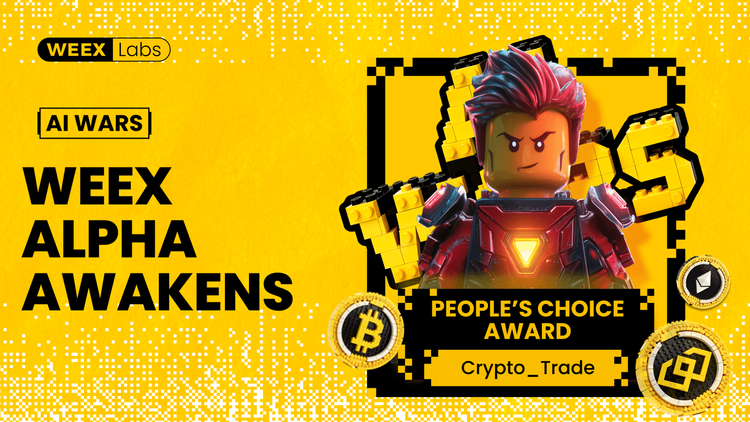
How a Structured AI Crypto Trading Bot Won at the WEEX Hackathon
Crypto_Trade shows how structured inputs and controlled adaptability can build a more stable and reliable AI crypto trading bot within the WEEX AI Trading Hackathon, highlighting a practical path toward scalable AI trading systems.
Particle Founder: The entrepreneurial insights I have gained the most from in the past year
Stop lean startup, stop lightning entrepreneurship, and think carefully about what your product aspirations are.
Huang Renxun's latest podcast transcript: The future of Nvidia, the development of embodied intelligence and agents, the explosion of inference demand, and the public relations crisis of artificial intelligence
The competition in the future is not just about whose model is larger or whose computing power is stronger, but also about who understands the industry better, who can embed AI more deeply into real processes, and who can organize these capabilities into a runnable and scalable system.
OKX Ventures Research Report: AI Agent Economic Infrastructure Research Report (Part 1)
The existing infrastructure is hostile to the Agent economy. Agents can think and act independently at the "capability level," but at the "economic level," they are still locked into infrastructure designed for humans.
The migration of settlement rights: B18 and the institutional starting point of on-chain banks
In the traditional system, banks decide the settlement; in the on-chain system, code begins to take over this responsibility.
From Tencent and Circle: Looking at the Simple and Difficult Questions of Investment
The AI narrative continues to ferment, but the recent performance of related stocks varies, with some in the midst of summer and others as if in winter.
The second half of stablecoins no longer belongs to the crypto circle
What Coinbase doesn't want, Mastercard is eager to buy.


 App
App